Thursday, April 12, 2018

Amanda Smith Stewart Letter


Amanda Smith Stewart is my 3rd great mother. Amanda married Ira Stewart, my 3rd great father in 1811. Her father Hubbard Smith married Ira's sister Seviah Stewart and lived in Harpersfield,Delaware,NY. 

Amanda mentions that she wrote this from memory and for Hiram Stewart, her grandson and son of John Wilcox Stewart, to correct some of her mistakes.  Amanda was 75 at the time of the letter and had an excellent memory.  She only made a couple of name mistakes. Mary Hubbard's father is Jeremiah Hubbard not Asa Hubbard. David Smith was Lt. David Smith in the French and Indian war.  Daniel Stewart's grandfather was Alexander Stewart not Charles and Daniel's first wife was Phebe Lee Chapman.  Phebe Stewart moved to New Hampshire and not Vermont. Her husband's name is Perley Buck not Parley. This letter is amazing for the fact that Amanda didn't have benefits of the Internet to fact check.  This letter is also posted on my Ancestry account along with the transcribed version.


Tuesday, January 2, 2018

Saga of the Hocking Photo Collection

To row from left to right, Homes built by Daniel Stewart now standing. 1) Built 1815-17 at Stewart, caption below read The Ancient Stewart Home at Stewart. 2) Copeland home at Stewart built 1836. 3) The Halbirt-Grover Sutton home built near Canaanville, built about 1814 as a wedding gift for his son, William.  William married Julia Hulbert who died in 1823. William married for his second wife Julia Ann Carpenter. In 1840, William moved his family to the Iowa Territory and settled in Fort Madison. 4) Graves of Ruth and Daniel Stewart. Interestingly Daniel's third wife Lovisa Williard Stewart is not listed in the West Side Cemetery. 5) Etchings from a portrait. 6) Hocking river in flood. Enterprise launched here. 7) Grave of Nathaniel Sawyer, Pioneer Cemetery on Federal Creek. Nathaniel's wife is Lydia Porter. After Nathaniel's death, Lydia married our 4th great uncle Archelaus Stewart. Lydia Porter Stewart died in 1849 and is also buried in West Side Cemetery.  In 1850, Archelaus moved to Adams County,IL and he died there in 1854. Archelaus Stewart is buried in Camp Point, Adams County,IL.  8) John Stewart and fly leaf of "Highways and Hedges". 9) Judge Hatch's log cabin built in 1810. 11) Mother Stewart author of "The Crusade".  Eliza Daniel Stewart was a leader in the Women's Temperance Crusade.  During the civil war she serves the wounded soldiers as well as standing guard while on picket duty protecting against the threat of Morgan's Raiders in 1863. 12-14) Sons and daughters of Daniel Stewart from portraits, photographs and tine types 1831-1871. None of the photos are identified. Sadly we've all encountered this problem. This generation believed that there would always be someone living who could identify the person in the photo.  There is a note indicating to see Vol II.  


Wednesday, June 7, 2017

Charles Henry Byron author of The Saga Of The Hocking

Before we explore the book, The Saga Of The Hocking, I'll explain the background of the author. Charles H Byron is the great great grandson of our 4th great uncle Daniel Stewart Jr.  His line encompasses his great grandparents Daniel Bertine Stewart and Sarah Carter.  Their daughter Ruth Stewart married Charles Bryon and their son Edward Stewart Byron and Bertha Zimmerman are his parents.

Charles was born in 1899 in Stewart, Ohio.  He is the eldest of three and describes himself as a poor student.  In 1927, Charles left Ohio and moved to Chicago,where he took up residence at the Jane Addams Hull House. His cousin William Fisher Byron and his wife Evelyn Soderlund were also living at Hull House.  William Fisher Byron was an assistant professor of Sociology at Northwestern University in Evanston.  His wife Evelyn was a social worker.

Hull House was initially intended for recently arrived European immigrants but expanded to thirteen buildings where leaders of business, education, social work, authors and the arts could live and interact with the surrounding community. Hull House is situated on Chicago's West side at 800 S. Halsted.  Only two of the original buildings remain today. Charles lived at Hull House from 1927 until he married in 1931 and moved to Denver.   During his time living at Hull House, he taught painting classes. In the 1930  Federal Census he was working as a commercial artist at a lamp shade company.

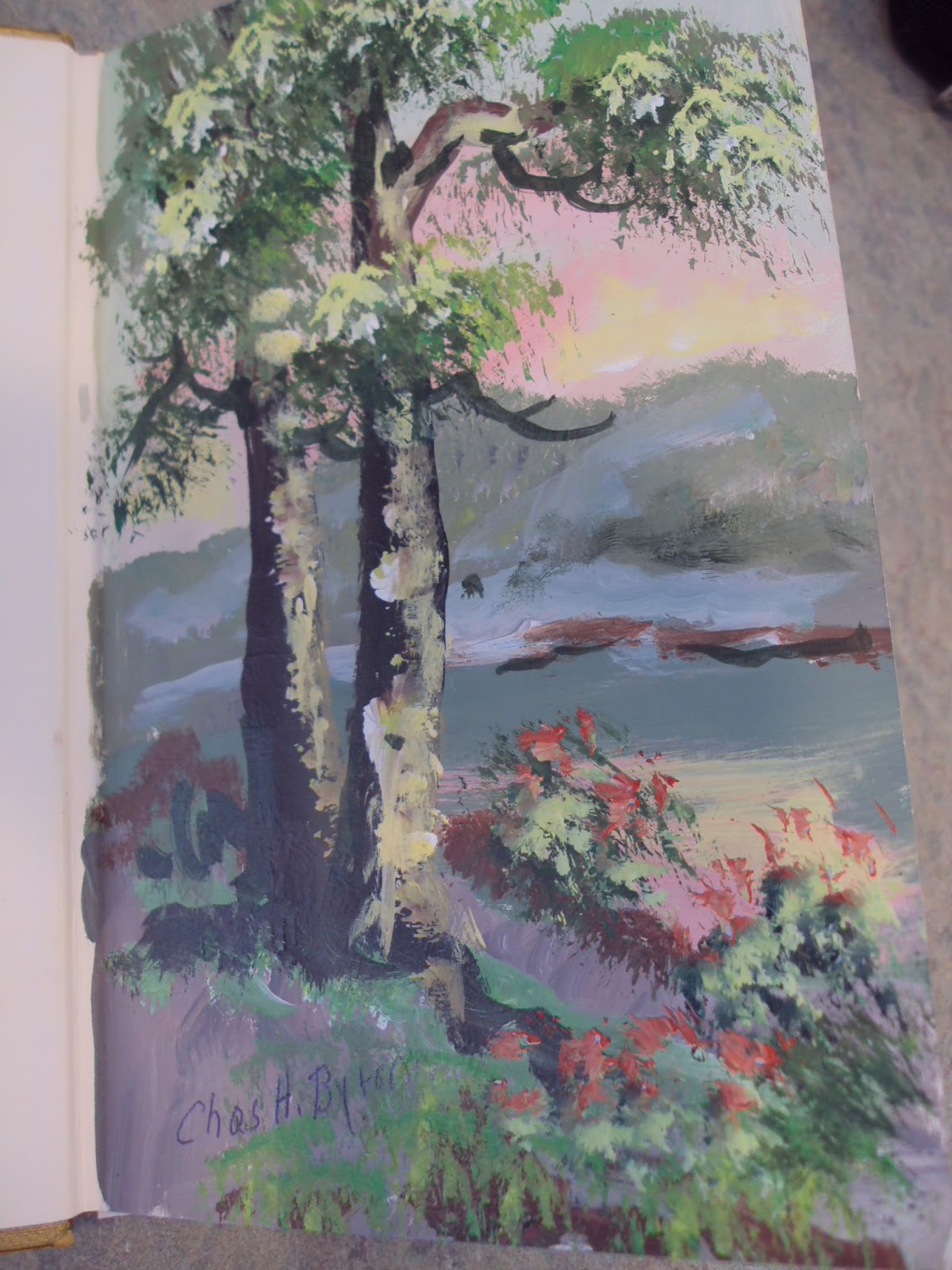
Charles used his artistic talents to illustrate the book. The color photo is done in oil.  This is the only picture in the book that is in color. Each chapter of the book will have it's own post and some chapters will have many posts due to the information they contain.  Unfortunately, a diary kept by Daniel's first son William Stewart was lost.  Daniel's seventh son, John Stewart, a Methodist Episcopal minister, wrote Highway and Hedges and gives a brief description early life in Ohio. John Stewart's book also references Daniel Jr's third wife Lovisa Williard Stewart.  Charles mentions that nine chapters were deleted from this book and he hoped to carry over this material in a second addition. Sadly, no further book was ever published.

 The book contains some interesting family stories and also provides some information about missing members of our family. This books also had me exploring some 16th Century Scottish history that helped explain how our Stewart family left Scotland for Northern Ireland and ultimately America.

The back of the book reads:


Unable to conform to the organized school system that taught nothing that interested him, and with the slogan, “It is better to create than educate,” Bryon was a poor student. He did not even do the drawings in the high school annual and was flunked in second English. His ability in this field was not discovered until a later date.

In 1927 he left his home village of Stewart, Ohio, for Chicago where he studied at the Art Institute. Through a cousin, who was president of Hull House Association, he lived at this famed social center under Jane Addams for several years teaching art. In 1931 he married and moved to Denver. With a background of designing novelties, wall paper and draperies, he entered the Lamp Shade business and was the only manufacturer in the Rocky Mountain Region who survived the depression.

In 1937 he entered the mural decorating business and under the slogan “We go anywhere,” became one of the leading house decorators in the United States, doing many thousands of decorations in homes and business places. He painted quickly and easily. The hand-painted water colors in this book are produced in a few minutes each; therefore, they are not designed as works of art.

Having drilled two wells,shipping oil before he could vote, he again entered this treacherous oil business and is responsible for opening several oil pools in Kansas and Oklahoma.  Obtaining leases on acreage where Daniel Stewart drilled oil and salt water wells with spring poles 150 years prior, he interested Denver capital and a resultant wild cat at 4700 feet, which was the deepest test ever made in Athens County, Ohio, discovered oil and gas in a formation where none had been found within 25 miles. This opened a potential major oil field. He is also the owner of several apartment houses in Denver.

He made an extended six months tour of the world in 1961-62 to study modern mural decorating and the religious and political situations. He did over a score of murals and decorations in twelve countries including the A-Bomb Hospitals in Hiroshima and Nagasaki, Japan.

His present plan is to raise a few thousand dollars, return to Hiroshima, oversee and personally assist a badly needed re-painting project of a hundred rooms in this hospital at his own time and expense. He will be glad to hear from those interested in this international good-will gesture to one of our strongest allies.


Thursday, June 23, 2016

Thomas Shaylor 1643 - 1692 or 1705? One of the Founders of Haddam,CT

Our 8th great grandfather Thomas Shaylor, began his life in Warwickshire,England in 1641.  Warwickshire is a landlocked county in the West Midlands which is interesting because the sea dominated his life.  What we know of his early life in England is that his father's name was Roger and his mother's name is Elizabeth.  There is no record of his mother's name.  Roger and Elizabeth had another son, John Shaylor, who was born about 1638 and a daughter Elizabeth Shaylor baptized in 1647.  And interestingly, Warwickshire is the home of another of our ancestors, Christopher Smith and Alice Gibbs.  There is a burial record for Roger Shaylor dating 1671 but no records when his mother Elizabeth died.  And neither John or Elizabeth seem to have emigrated to America.

While researching Thomas Shaylor, I did locate another Shailer family in Killingworth that is connected to our family.   The Wilcoxson/Wilcox family are another of our original immigrates to America, our 9th great grandfather is William Wilcoxcon of Derbyshire England. The Wilcoxson family left England with their minister on the Planter and settled first in Stratford in 1639 and later Killingworth,CT.  It's William's son Joseph Wilcoxson, (our 8th  grandfather), where the other Shailer family member appears.  From the book, Descendants of William Wilcoxson of Derbyshire,England, and Stratford,CT by Thomas Wilcox published  1963, "It is pretty well established that the wife of Joseph Wilcoxson, Anna was a Shailer. In one place it is noted that a descendant of William Wilcoxson is the inheritor of 12 acres that were originally Goodman Shailers". Goodman Shailer is Anna Shailer's father.  The book mentions that this branch of the Shaylor/Shailor also lived in Warwickshire,England.  The Goodman Shailer's family first home in the Americas was the Island of Jamaica.  The family didn't remain long in Jamaica because they are mentioned as one of the first planters in Killingworth. The book also mentions that one of the early planters of Killingworth was Thomas Shailer. From: THE TWO HUNDEEDTH ANNIVERSARY OF THE FIRST CONGREGATIONAL CHURCH OF HADDAM, CONNECTICUT,  Our Thomas Shaylor, first lived in Killingworth and then removed to Haddam.  Given that Thomas Shaylor and Anna Shailor have different fathers, the closest relation would be cousins.

But back to our Thomas Shaylor, his residence in Haddam is established in 1669.  In either 1669 or 1670, Thomas marries our 8th great grandmother, Marah Allice Spencer, daughter of our 9th great grandparents Gerrard Spencer Jr and Hannah Hills Spencer. An interesting side note on Marah Allice Spenser is that in some records her name is reversed to Allice Marah. One record makes it clear that she wants to be know as Marah were it states "Marah not Alice". This seems to be a family trait that has been passed down to subsequent generations.    Thomas Shaylor is actually Marah Allice Spencer's second husband.  Her first husband is Thomas Brooks. The children of Marah and Thomas Brooks are:

Sarah Brooks - born 1662 m. William Lord 1677, 2nd Samuel Ingram 1702
Thomas Brooks - born 1664 m. Susannah Arnold 1695 d. 1734
Mary (Marah) Brooks - born 1666 m. Henry Smith 1689 d. 1701
Alice - born 1668 d. 1668

The Brooks family provides us with more aunts and uncles and cousins. Captain Samuel Brooks, our 2nd cousins marries our 6th great aunt Dorothy Smith, daughter of Lt. David Smith and Dorothy Brainerd.

The children of Marah and Thomas Shaylor are:

Capt. Thomas Shaylor (our 7th great grandfather) -  born 1670 m. Katherine Clarke
Abel Shaylor - born 1673 m. Elizabeth Ackley, 2nd Mary Parents, 3rd Hannah
Timothy Shaylor - born 1675 m. Elizabeth Parents, 2nd Martha
Nathaniel Shaylor - born 1677
Hannah Shaylor - born 1683 m. John Clarke (Katherine Clarke's brother)

The original town of Haddam is divided into the Upper and Lower Plantation.  The Connecticut River separates the two sections.  I've included a map of the town and you'll see some of  our familiar ancestors, Smith, Arnold, Spencer, Brainerd/Brainard,Cone, Clarke, Gates,Wells & Brooks in the Upper Plantation and the Parents, Shaylor, Ventres,Ackley in the Lower Plantation.

In either 1692 or 1705 depending on the source, Thomas Shaylor departs Haddam for a sea voyage and is never heard from again.  Some believe that he was on a trip to the West Indies and other sources believe that he was on a voyage to England to depose of some property still held by the family.  Thomas is not declared dead until after our grandmother Marah dies in 1714.  At that time the estate is divided among the living sons Thomas, Abel and Timothy.  Nathaniel Shaylor reportedly dies earlier in 1714.

The Haddam Historical Society website has some interesting information about the Shaylor and Tyler families.  The area of the Lower Plantation is renamed Shailerville.  From the Haddam Historical pages:

 Shailerville is the small village located just south of Haddam Center in what was originally called the Lower Plantation. The Shailer (also spelled Shaylor) Family created a tight-knit community that avoided outsiders. They were very wealthy ferrymen, merchants and sea captains who owned most of the land in the area. They deliberately isolated themselves from the rest of the town and were ardent Baptists. Many intermarried with first and second cousins rather than seek partners outside their community. Shailerville at one time boasted a post office, schoolhouse, factories and commercial stores.

The Shaylor family had close connections with the Tyler family who had their own community called Tylerville.  The Tyler family is the same branch that Amanda Smith Stewart mentions in her letter when she states that Alice Smith (Capt. James Smith's daughter) marries Joseph Tyler. Within the Shailerville-Tylerville communities is a cemetery called Shailerville Tylerville where many of our relatives are buried.

The Haddam Historical Society website also has a section on the Revolutionary War and privateering.   It is recorded in 1779 two British ships, the York and the Tyron were captured on the Connecticut River by Haddam made ships captained by Simon Tyler and Samuel Shaylor.  They are our 2nd cousin and 1st cousin respectively.   Seems like a good opportunity to contact the Haddam Historical Society to include our Capt. James Smith


Saturday, May 7, 2016

Naaman Spencer and Family

Before I tell you about Naaman Spencer, let me explain who the Spencers are to our family. Our original immigrant ancestor is Gerrard Spencer who was born in England in 1614 and immigrated first to Massachusetts and later settled in Haddam,CT.  It is from his descendants and siblings descendants that make up the Spencers in America. 

I first came across Naaman Spencer through our 3rd great aunt Eunice Amanda Stewart. Eunice is the daughter of our common 3rd great grandparents Ira Stewart and Amanda Smith Stewart.  Eunice married William Stephenson Jenkins and William's brother,James Henry,married Naaman's daughter Lucinda Spencer.  Naaman's Find A Grave obituary gave me more information to connect him to our family.  The obituary mentions that he was born in Hartford County,CT and came first to Elkhorn Grove, Carroll County,IL in 1838 with his son Allen B Spencer. So this meant that he was living very close to our great great grandfather Hiram McNamer.  

I pulled the 1840 census for Carroll County and found both A Spencer and Hiram McNear. They are listed very close to each other in the census.  The 1840 Census combines the whole county and doesn't breakdown by township. And the census takers handwriting is terrible.  I corrected Hiram's last name to McNamer. 

Naaman's obituary also mentions that he later moves his family to Eagle Point,Ogle County,IL.  And he is living very close to our 3rd great uncle John Wilcox Stewart family and Michael O'Kane who's son Edwin O'Kane marries our 2nd great aunt Nellie McNamer. If you look at our Ancestry tree in Naaman's son Naaman Jr along with Jasper Davison are issued a patent for a gang-plow. He manufactured and sold the Defiance Gang Plow.  So Naaman Jr. is in direct competition with John Deere.  There is a plaque west of Polo,Il on Telegraph Road on the site of the plow factory.

I was also able to go back another generation through Find A Grave to Naaman's father Michael Spencer. There is an interesting letter that has been posted on his Find A Grave Memorial. From Michael Spencer, I was able to go back another generation and that's when it got interesting.

Michael Spencer's grandparents are John Spencer and Mary Hubbard. Let me stop there and explain how the Hubbard family is related to us.  Our original immigrant Hubbard ancestor is George Hubbard who also was born in England and settled in Haddam,CT. George Hubbard was born in 1601 and arrived in Haddam about 1635. Our common 5th great grandmother Mary Hubbard is a descendant of George Hubbard and she married our Capt. James Smith.

It was time for me to pull our my One Thousand Years of Hubbard History book by Edward Warren Day, to find out how Naaman Spencer's great grandmother Mary Hubbard fits into our family. Mary is born in 1713 and dies in 1802.  It turns out that this Mary Hubbard is our 2nd cousin making Naaman Spencer our 5th cousin, several times removed for both. Mary Hubbard's husband is John Spencer, our 3rd cousin. The Hubbard History book covers the years 866 to 1895.  I use it frequently to trace the family lines. 


Naaman Spencer Sr


Naaman Spencer Jr


Sunday, April 24, 2016

The Lockett family of Adair County,KY and Carroll County,IL


Adair County, KY July 6th 1851
Dear Sir,
I take this opportunity of addressing you a line by way of inquiry. I recd a letter from my Nephew William Lockett dated April the 1st 1850 he informed me that himself and his brother James would start the next morning to California and if he lived to reach his place of destination he would instantly write to me and inform me where they were and also request me to write to him as soon as should receive a letter from him. I have not recd a line nor heard a word from them since that time. I therefore make this request of you that you write to me immediately on the receipt of this letter and give me some information Respecting them whether they went and whether James took his family and whether you have heard from them where they are and all the information you can about them. Also inform me how you are all coming on in that country. I should be truly glad to see my connections in that country if there are any of them still remaining there. Brother David felt near and dear to me so does his children and grand children - my self and family are in common health at this time. During last fall and winter seven of us had Typhoid fever we lost our second daughter Martha Frances. She departed this life on 2nd day of March last in the 14th day after taken. Myself and wife and three of our little boys had long and sever spells. My Self and wife were confined to our beds forty days the children not quite so long. Our oldest son had a light attack in the fall - Daniel Lockett lost his wife and five children during the fall and Early part of the winter only leaving him one child David Thomas he is about 25 years old. He lay about two months he was given up by Physicians and friends but finally recovered. - The health of our country is rather better this summer thus far than it has been for 2 or 3 summers past. Our country is in a prosperous condition at this time produce and stock sells readly at good prices - wheat crops is tolerable good corn and tobacco crops look promising at this time. Nothing more at present give my love to all my connections in that country and your daughter in particular. Write to me immediately for I am very anxious to hear from you all - Direct your letter to graidville Post office Adair County Ky. Accept my best wishes while I remain yours
- Solomon Lockett
To - Mr Hiram Mc Neamer
Nanette White  - has given us the background for this letter.
Through her efforts we can now read the "story" (April 28, 2012)
I continue to find family information for my family in Carroll County . This letter is to my gg grandfather Hiram McNamer from Solomon Lockett. My grandfather Hiram McNamer was married twice; his first wife was Emeline Lockett. Hiram and Emeline were married in Daviess County , Ky in 1833. Shortly after marrying, Hiram and Emeline move to Carroll County , IL between 1834-1835. My great grand aunt Martha (Mattie) McNamer is the only child to survive from that marriage. Family legend has a story that Emeline died during childbirth along with the twins she was carrying in 1843. After Emeline died, my grandfather married Maria Elizabeth Stewart from whom all of us are descended.


Last year I came across your interesting obituary for James Howard Lockett in the Carroll County Genealogy site. Since I wasn't sure how he might be related to Emeline Lockett, I just kept the info in the back of my mind. The discovery of the letter explains the full story of James Lockett and the rest of the Lockett family. James Lockett married Juliamiah Webster in Carroll County in 1845. I located an 1850 Census for Elkhorn Grove that lists his wife and three children (Elvira, Isabella and James William) and a William Lockett age 22. I decided to work backwards and try to locate birth records for Emeline and James Howard. Early records in Kentucky are very hard to locate. The state and Daviess County in particular have been plagued by numerous fires in their county court buildings so I used the letter and the Carroll County probate records to piece together the family history.

David Lockett is the father of Emeline, James Howard, Martha,Susan and William Lockett. David Lockett, Solomon, and Daniel Lockett are brothers and were born in Virginia or what may be modern day West Virginia . David Lockett moved his family to Carroll County about the same time that my grandfather Hiram McNamer came to the county. The Carroll County Probate records have David Lockett's will which lists the children and his "beloved wife".

David Lockett died in 1844 and his will is probated in December 1844. I can't locate any information on his "beloved wife" or daughters Martha and Susan.
So what happened to the rest of the people in the story?
Solomon Lockett moves his family from Adair County , KY to Lavaca County , TX sometime between 1853-1860. I located the family in an 1860 Census minus Solomon. His sons David, William and Joseph join the Texas militia and later the CSA. There are no further letters that I could find between Solomon Lockett and my grandfather Hiram McNamer. I don’t think James Howard returned to Kentucky before Solomon moved his family to Texas .
Daniel Lockett and his remaining son David Thomas disappear after the 1850 Adair County Census records.

William and James Lockett do leave for the Gold Rush in Colusa County , Ca. And they do arrive there alive. But by the time Solomon Lockett writes the letter to my grandfather Hiram McNamer, William Lockett is dead. The Carroll County probate records discover that he died in November 1850 in Colusa County , Ca. It's not until 1856 that Carroll County officially declares him dead. The Carroll County Probate records indicated that William Lockett’s Estate took care of the needs of James children ( Elvira, Isabella and James William).

Juliamiah not knowing that her husband James Howard is still alive, marries Henry K. Taylor in 1866.  Both Juliamaih and Henry are buried in the South Elkorn Cemetery.

Obituary for James Howard Lockett from the Carroll County IL GenealogyTrails site.  Original letter posted on same site.


JAMES HOWARD LOCKETT - Word was recently and surprisingly received of the death of James Howard Lockett formerly of Milledgeville. Mr. Lockett had been presumed dead since his departure to the California Gold Rush in 1850. In a letter recently received by his son Will Lockett it seems Mr. Lockett not finding his riches in the gold fields returned to his native Kentucky until the time of the War of the Rebellion. He enlisted and served with Company A 10th Kentucky Calvary CSA until the end of the late war, he then settled in Natchez Mississippi where he resided until the time of his death. His Burial took place in the CSA Cemetary in Natchez on 5 Nov 1893. He was the father of Mrs Ephraim , Elvira, Pay, Mrs . George , Isabella ,Green and Mr. Will Lockett all of Milledgeville.
Contributed by Gary Shaw

Philo Penfield Stewart

Philo Penfield Stewart is our 2nd cousin, of course 4x removed.  His parents are Philo Stewart and Sarah Penfield. The senior Philo died at an early age in 1812. Philo Jr, then went to live with grandfather John Penfield in Pittsford,VT. Philo Jr's mother Sarah remarried Thomas Hammond. Thomas Hammond is mentioned in an article attached to John Penfield from our site.

Philo Penefield Stewart is the second Indian missionary in our family. David Brainerd is the first on the Smith side of family.  Be sure and take a look at David Brainerd on our site.  I was able to find a painted picture of him and his grave.


PHILO PENFIELD STEWART (1798-1868), STOVE DESIGNER AND RELIGIOUS REFORMER - From the History of Rensselaer County NY-  Just a century ago, in 1868, there died in a house on Fifth Avenue in Troy a man who occupies an unusual place, not only - in Troy's, but also in our national history. The man was Philo Penfield Stewart, and he exemplified, as did many others of his time, the various types of men who lived and labored in Troy during that period of great activity and growth in the city's history. Like many others at the time, Emma Willard, General John Wool, Amos Eaton, and William Marcy, to name only a few, Philo Stewart was not a Trojan by birth. Born in Connecticut, like others of Troy's early leaders, Philo Stewart grew up in Vermont, at Pittsford, where he lived with his grandfather and was apprenticed to his uncle, a harness maker at Pawlet, Vermont. He showed early talent for mechanical inventiveness and he expressed it in a wide variety of whittling devices. 

Young Philo also developed strong religious interests, although he was never ordained to the ministry. He was converted to many of the reform movements of his time, among them temperance, anti-tobacco, abolition, and the like. At the age of 23, he enrolled with the American Missionary Board and departed on a long horseback ride for Mississippi, where he engaged in missionary work among the Choctaw Indians, teaching school, preaching, and performing many other useful labors. 

Here, in Mississippi, young Stewart married a fellow-missionary, also from Vermont, and the couple, remaining childless, jointly dedicated their lives to many good causes. They made their way to Elyria, Ohio, where they found Philo's schoolmate, the Reverend John Jay Shipherd, serving as a minister there. The two men now embarked on an ambitious venture, no less than the foundation of a college and colony. It was to be no' ordinary college, but a novel and radical experiment in education. This was "Oberlin Collegiate Institute," now Oberlin College, established in 1833, in Ohio's Western Reserve. It was the first school to adopt a system of full co-education for both sexes, and it accepted Negro students in a program of complete integration. Stewart also sponsored the idea of combining education with labor for the support of the students. For several years Stewart and his wife headed the boarding and labor department of the new college, like the
students, working only for their keep. 

At this time, too, in connection with his work in Ohio, Stewart applied his mechanical ingenuity to practical purposes. He developed a planning machine, and he particularly began. work on an improved stove, which was at first called the "Oberlin Stove." In 1837, Stewart left Oberlin College and came east again, somewhat disappointed with Oberlin's lack of what he considered proper zeal and dedication. It was a year of great depression, and the Stewart couple experienced poverty and deprivation. Stewart, however, became the more determined to improve his earlier stove design and to make it most economical for the poor to use, He succeeded with what was now called the "P.P. Stewart Summer and Winter Cooking Stove." Then arose the problem of its manufacture and distribution, for which Stewart lacked the means and facilities. 

It was in 1838 that Stewart "fixed on Troy as the place for making his stoves." Troy was already then a stove-manufacturing center of some importance, and it was, indeed, developing a reputation as a growing industrial city, especially in the metal field. Stewart, too, knew Troy, since he had visited it previously on his trips to and from Vermont. Here he settled in 1838 and remained for the remainder of his life, until his death in 1868. He entered into an agreement with Fuller, Warren and Company for the manufacture and distribution of the stove. It was a successful arrangement, and both parties prospered. Over the thirty years of Stewart's business career, 

The firm made more than ninety- thousand stoves in its Clinton Foundry, still standing south on River Street and now occupied by several small industries. The Stewart stove became nationally known, and President Eliphalet Nott of Union College, himself a stove designer, praised it highly: "All that is of value in other stoves is taken from the Stewart." After Stewart's death, his stove continued to be the basis of Fuller, Warren's prosperity. 

For Stewart, however, the successful manufacture of his stove was not the end hut a means toward a higher purpose. His object, as he put it was "not to make money for himself, but to provide a boon that cannot be reached by dollars and cents." He lived simply and sparingly in a house on Fifth Avenue, recently razed in connection with urban renewal. His profits from the stove were largely distributed among many good causes, including in particular the continued support of Oberlin College. He was concerned with right living as well as right doing, and he espoused many reform movements. His house in Troy was "open wide to care for all visiting missionaries, Christian agents, ... and to God's poor and sick of whatever race or creed, though I divide my last loaf." He maintained there a school for the education of illiterate servant girls. His religious zeal extended to embrace such aspects of "right living" as "proper diet, modes of dress, and all habits and
practices of body, soul, and spirit." 

Although, or perhaps because both Stewarts were sickly, they developed great interest in "diet, rest, and exercise. " Stewart even established for a time in Troy a "hygienic institute" which relied on a "water cure" as a "depurator or cleanser" of the body's ills. He developed an unusual system and philosophy of gymnastics, which anticipated modern theories of exercise in some -respects. Altogether this was an unusual couple living in Troy a century ago, combining business with religion and reform. 

His death, on December 13, 1868, was mourned by many. 

This article is from the Good Time Stove Company.(http://www.goodtimestove.com/)


Link to Oberlin College:

http://new.oberlin.edu/about/history.dot


Philo Penfield Stewart